Explore how AI is transforming wealth management in 2026 through real-world examples, use cases, and emerging trends in portfolio management, personalization, compliance, and automation.
AI in Wealth Management: Examples, Trends, and Use Cases for 2026
AI in wealth management refers to machine learning, natural language processing, and predictive analytics technologies. These technologies automate portfolio management, tailor financial advice to each client, and make compliance operations easier. The AI in wealth management 2025 market is valued at USD 20.8 billion in 2024 and expected to reach USD 129.6 billion by 2034, growing at a 20.2% CAGR. Half of wealth management executives already use generative AI in wealth management.
The move toward AI-powered advisory services is more than just a small step forward. AI in wealth management tools like ChatGPT, Perplexity, and Google's AI Overviews are changing the way people look for and use financial advice.
What Is AI in Wealth Management?
AI in wealth management includes tools that look at financial data, guess what will happen in the market, and do advisory work automatically. These systems look for patterns in huge amounts of data that people cannot see. Machine learning algorithms, natural language processing, and predictive analytics engines are all common parts of the technology stack.
Over time, the evolution has gone through three different technological stages.
• Traditional AI was good at rule-based automation and simple interactions with chatbots for clients.
• Generative AI can now make personalized content, summaries of meetings, and research synthesis.
• Agentic AI is the newest frontier in AI, with systems that can plan, decide, and carry out tasks on their own.
| AI Technology Type | Primary Function | Wealth Management Application |
|---|---|---|
| Machine Learning | Pattern recognition | Portfolio optimization, risk scoring |
| Natural Language Processing | Text understanding | Client communication, document analysis |
| Predictive Analytics | Trend forecasting | Market predictions, client behavior modeling |
| Generative AI | Content creation | Report drafting, meeting summaries |
| Agentic AI | Autonomous execution | Multi-step task completion, compliance workflows |
Top AI Use Cases in Wealth Management
According to Level Agency research, AI-powered search tools now give direct answers right in the search results, which often means that users do not have to click on links to get to the information they want.
1. AI-Powered Portfolio Management and Optimization
AI-driven wealth management software analyzes vast datasets to craft investment strategies rooted in data. Machine learning models process historical data, behavioral patterns, and macroeconomic trends simultaneously.
With real-time intelligence, AI portfolio management becomes proactive instead of reactive. Investment teams gain clearer understanding of how strategies behave through stress events.
2. Automated Portfolio Rebalancing
AI-based portfolio rebalancing improves asset allocation by adjusting investments to market shifts. Automated systems can process complex portfolio adjustments in minutes rather than hours.
These tools reduce rebalancing costs by 60-70% through optimized trade generation and execution efficiency. AI tracks asset performance in real-time and identifies when adjustments are necessary.
3. Personalized Financial Advice and Planning
Robo-advisors harness advanced algorithms to develop automated investment strategies custom-fit for clients. AI evaluates client risk tolerance, financial goals, and market conditions for tailored strategies. These digital tools can track client milestones like marriage or retirement goals automatically.
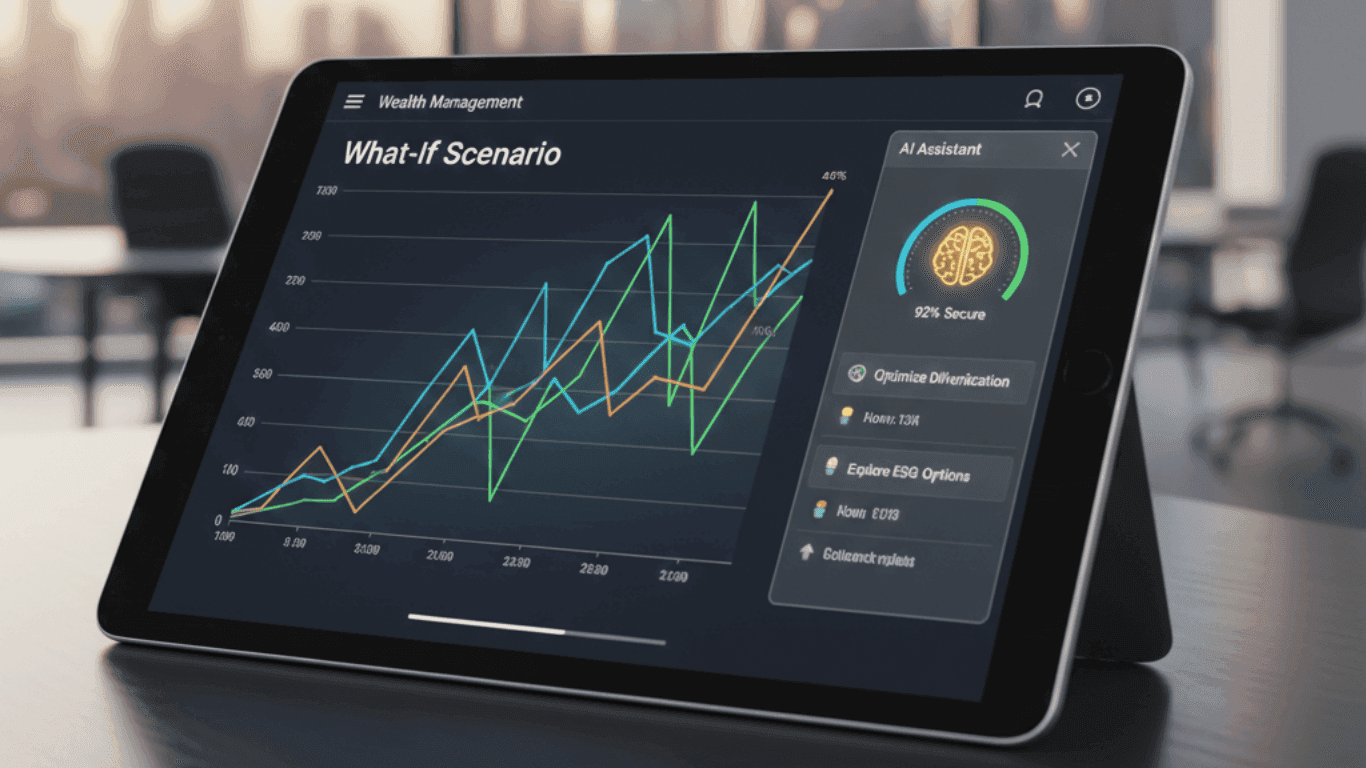
AI-powered systems run hundreds of "what-if" scenarios instantly for better decision-making. Vanguard's robo-advisors manage substantial assets using these personalization capabilities effectively.
4. Risk Management and Fraud Detection
AI algorithms evaluate financial risks in real-time, helping institutions mitigate market volatility. These systems analyze large transaction volumes to recognize unusual fraudulent activities immediately. Behavioral analysis monitors user activity patterns and highlights accounts showing compromise signs.
Predictive analytics provide insight into future risks by examining historical trends continuously. AI-driven systems detect anomalies by continuously monitoring transactions and market patterns.
5. Automated Client Onboarding and Document Processing
AI automates document review, tagging, and compliance checks to accelerate onboarding significantly. Natural language processing extracts key information from contracts and financial statements automatically. Robotic process automation validates trade settlements and flags discrepancies for human review.
Time-to-model can drop by 50-75% while policy breaches fall below 1%. This automation allows wealth managers to focus on high-value strategic activities.
| Use Case | Top App | Key Features | Pricing | Link |
|---|---|---|---|---|
| Portfolio Management & Optimization | Range | AI-powered portfolio analysis, tax projections, retirement strategies, delivers advice 10-20x faster | Starts at $2,655/year | https://wallstreetzen.com |
| Fiscal.ai | Institutional-grade data from S&P, conversational AI interface, customizable dashboards | Free (10 prompts); Premium $24/month | https://fiscal.ai | |
| Orion Advisor Tech | Portfolio management, rebalancing, CRM, client portal, automated workflows | Custom pricing | https://crunchbase.com | |
| Automated Portfolio Rebalancing | UREBAL by SoftPak | Pair-wise swap methodology, tax-efficient rebalancing, unified household management | Custom pricing | https://softpak.com |
| Smartleaf | Tax efficiency optimization, continuous monitoring, personalized strategies at scale | Custom pricing | https://softpak.com | |
| Tamarac by Envestnet | Automated rebalancing, trading automation, CRM integration, compliance features | Custom pricing | https://crunchbase.com | |
| Personalized Financial Advice | Wealthfront | Daily tax-loss harvesting, automated and DIY portfolios, low 0.25% fee | $500 minimum | https://nerdwallet.com |
| Betterment | Automatic rebalancing, personalized retirement plan, impact investing options | No minimum; Premium requires $100K | https://bankrate.com | |
| Vanguard Digital Advisor | Vanguard ETFs, automatic rebalancing, tax-loss harvesting, CFP access at $50K | $100 minimum; ~0.20% fee | https://unbiased.com | |
| Risk Management & Fraud Detection | Nitrogen | Risk Number calculation, portfolio risk analysis, tailored investment recommendations | Custom pricing | https://lynkcm.com |
| Kensho | AI-driven analytics, event recognition, market movement forecasting | Enterprise pricing | https://lynkcm.com | |
| Alphasense | NLP-powered market intelligence, financial document analysis, timely insights | Custom pricing | https://lynkcm.com | |
| Client Onboarding & Documents | Masttro | AI-driven document collection, data extraction, 650+ custodian integrations | Not AUM-based | https://masttro.com |
| Canoe | AI-based data extraction, automated workflows, document management | Custom pricing | https://masttro.com | |
| Addepar | Data aggregation across all asset classes, portfolio analytics, client portal | Custom pricing | https://rightcapital.com |
Generative AI vs Agentic AI in Wealth Management: Key Differences
Wealth managers can make better choices about which technologies to invest in if they know about these AI types. Generative AI makes content, and agentic AI does multi-step tasks on its own. Both have their own pros and cons, depending on the needs of the client and the workflow.
| Feature | Generative AI | Agentic AI |
|---|---|---|
| Primary Function | Content creation, synthesis | Autonomous decision and action |
| Human Involvement | High, prompt-driven responses | Low, goal-driven execution |
| Example Use Case | Draft client email, summarize meeting | Execute full portfolio review autonomously |
| Learning Style | Pattern recognition from training data | Continuous self-improvement loops |
| Scalability | One model handles multiple functions | Specialized agents per domain task |
Generative AI Use Cases in Wealth Management
Generative AI is great at writing personalized client reports and summarizing research. JPMorgan's IndexGPT uses generative AI to automatically create personalized investment portfolios. It looks at market data, makes predictions about trends, and always suggests the best portfolio allocations.
Meeting assistants are the fastest-growing use of generative AI in wealth management. Advisory firms are quickly adopting tools like Zocks and Jump. WealthTech Today's buyer's guide looks at the best AI notetakers that work with CRM and automate compliance.
Agentic AI Applications for Autonomous Wealth Management
Agentic AI is a type of AI that can plan and act on its own to reach a specific goal. Companies hire dozens of digital experts with specific knowledge in different areas to do different tasks. One agent takes care of prospect insights, and another automatically writes suitability letters.
The Celent WealthTech Trends report shows that agentic AI is the real turning point for 2025. These systems can do multi-step tasks like full portfolio reviews on their own. Companies want client service solutions that can grow with them, so they adopt them when they have limited staff.
Real-World AI in Wealth Management Examples and Case Studies
JPMorgan Chase: IndexGPT and AI-Powered Investment Plans
With IndexGPT, an AI-powered tool made to give advanced investment strategies, JPMorgan Chase has shown that it is a leader in financial innovation. This system uses generative AI in wealth management to make personalized investment portfolios that meet the specific needs and risk tolerances of each client. Adding AI in wealth management has greatly improved the quality of service and the results for clients.
• IndexGPT looks at market data and makes predictions about trends to suggest the best way to divide up a portfolio
• AI in wealth management examples include personalization using machine learning and data analytics to make investment strategies that are very specific to each person
• JPMorgan said that between 2023 and 2024, its gross sales went up by 20% because of use of AI in wealth management
Morgan Stanley: Next Best Action System and AI Trends in Wealth Management
Morgan Stanley's Next Best Action system is a great example of how AI in wealth management 2025 is changing personalized wealth management services. The platform helps financial advisors make quick and accurate investment offers by knowing what their clients want. This system shows how useful AI can be for making sure that services meet changing customer needs.
• AI looks at how clients act to quickly suggest the best investment products for them
• By automating the processes of research and making recommendations, the system makes advisors more productive
• Morgan Stanley uses AI-advisors in wealth management during the Morgan Stanley Debrief as an aide during meetings with clients
BlackRock: Aladdin AI in Asset and Wealth Management Risk Analytics
BlackRock uses its Aladdin platform to make data better and easier to analyze so that it can make better decisions. The system helps asset managers all over the world find early signs of financial risk and figure out how strong their portfolios are. This AI in wealth and asset management method gives wealth managers the tools they need to respond quickly and effectively to changes in the market.
• Aladdin helps asset managers find financial risks that are just starting to show up in different economic situations
• The platform analyzes data in real time and makes predictions to find risks
• Agentic AI in wealth management makes it easy to quickly change investment strategies based on identified risks
Wealthfront: A Robo-Advisory Platform That Uses AI-Advisors in Wealth Management
Wealthfront's robo-advisory platform shows how well gen AI in wealth management can work in unstable market conditions. The automated investment service based in California uses AI algorithms to look at how clients save and spend their money. Their platform automatically figures out the best steps to take to reach each person's financial goals in the most efficient way.
• During the pandemic, Wealthfront saw a 68% increase in new accounts
• AI algorithms make personalized asset allocation plans based on how much risk each client is willing to take
• Tax-loss harvesting and automatic portfolio rebalancing are two examples of generative AI use cases in wealth management
PayPal and Feedzai: How AI Is Transforming Compliance in Wealth Management
PayPal and Feedzai show how AI is transforming compliance in wealth management operations. These systems handle millions of transactions every day while making sure that security and rules are followed. Before clients lose money, machine learning algorithms find strange activities.
• Using AI-powered systems, PayPal was able to cut down on fraudulent transactions by 30%
• According to Accenture, AI in wealth management solutions like Feedzai's machine learning algorithms look at transactional data to quickly find possible risks
• AI systems can adjust to new threats and fraud techniques thanks to continuous learning, representing the future of AI in wealth management marketing as security becomes increasingly important
AI SEO and GEO Strategies for Wealth Management Firms
AI engines like content that is short, to the point, and answers questions first. AltaStreet's keyword research finds high-intent SEO keywords that match how serious prospects search. Schema markup, Q&A formats, and original data make it much more likely that you will get cited.
Story Envelope's SEO analysis shows that good SEO gets you recommended by LLMs. You will also show up in Google's AI Overviews, which will bring relevant traffic to your site. Building content clusters around pillar topics signals depth and expertise to AI systems.
| AI SEO Element | Traditional Approach | GEO Optimized Approach |
|---|---|---|
| Keywords | Single keyword targeting | Topic cluster development |
| Content Structure | Long-form narrative | Answer-first, scannable format |
| Authority Signals | Backlinks, domain authority | Expert attribution, citations |
| Local Optimization | City pages | Niche plus location combinations |
| Schema Markup | Basic implementation | FAQ and HowTo structured data |
Best Ways To Use AI In Your Practice As A Wealth Manager
There are more and more ways that wealth management companies are using AI. For example, they are using AI to help with onboarding, portfolio monitoring, and client engagement. The goal is not to replace human expertise, but to make it better by automating boring tasks and giving people data-driven insights.
• Begin with low-risk, high-impact tasks like automating data entry or summarizing market news
• Use AI-powered tools to look at data, make reports, and write emails to clients
• Use robotic process automation to check trade settlements and mark any differences for review
What Are the Best AI Tools for Wealth Managers to Learn?
Generative AI in wealth management is becoming a must-have for advisory firms that want to stay ahead of the competition. Morgan Stanley uses generative AI to let financial advisors search, summarize, and access thousands of internal research documents while they talk to clients.
• Tools that use AI to summarize make quick pre-meeting briefs from client data and call transcripts
• Robo-advisors help with figuring out how much risk you can handle, making financial plans, and tax-loss harvesting
• Tools for processing natural language get client information from KYC forms and sort it in seconds
AI in Wealth Management Course Offerings for Professionals
The growing demand for AI expertise has led to the development of specialized AI in wealth management course programs. Leading universities and professional organizations now offer certification programs that combine financial knowledge with AI technical skills. According to Financial Planning Association data, advisors who complete these courses see a 30% increase in client acquisition.
Conclusion
Wealth managers are starting to see that AI in wealth management is both a chance and a problem for their business. The secret to success is to use a hybrid model that combines the speed of AI with the unique skills of people. The next generation of successful advisors will know how to use these tools while also building stronger relationships with clients.
FAQs
Will AI take the place of human wealth managers?
AI is not likely to completely take over the role of human advisors anytime soon. Most experts think that a hybrid model will become the norm. People use their emotional intelligence to handle complicated relationship problems. AI takes care of the data, while advisors work on the client's strategy.
What role does AI play in managing wealth right now?
AI looks at huge amounts of data to make predictions about how the market will behave. Companies use algorithms to make investment content very personal for each client. Automation tools take care of regular tasks like onboarding new clients and making sure they follow the rules. This lets companies work much more efficiently.
What do high-net-worth clients get out of it?
Clients with a lot of money can use tools to keep an eye on their portfolios in real time. AI makes it possible to instantly harvest tax losses to boost net returns. Systems reduce risk faster than the usual quarterly review cycles. Customers get service that is tailored to their specific life goals.
Is it safe to use AI in wealth management when it comes to data privacy?
Companies that are safe use private models to keep client data safe. Advanced AI can find possible patterns of fraud faster than people can. Enterprise security protocols make sure that private financial information stays private. Always ask your company what specific security measures they have in place.
Is AI better at picking stocks than human advisors?
AI processes unstructured data more quickly so that trades can be made right away. People are still better at long-term strategy and coaching people on how to behave. Technology helps people make decisions, but it doesn't guarantee that they will win in the market. Often, the best results come from using both methods together.